Children often keep asking “why” because they want an explanation. Research with preschoolers found that they were more likely to repeat a question after an answer that did not explain anything. After an explanation, they were more likely to agree or ask a new follow-up question.1
You thought you were putting on a coat. You have instead been appointed to explain weather, clothing and the existence of sleeves.
An answer is not always an explanation
“Because I said so” describes who is in charge. It leaves the original question largely untouched.
Frazier, Gelman and Wellman studied both recorded family conversations and conversations arranged in a laboratory. The pattern suggests that preschoolers are actively looking for information, rather than simply producing another turn in the conversation. It does not mean every repeated “why” has the same purpose.1
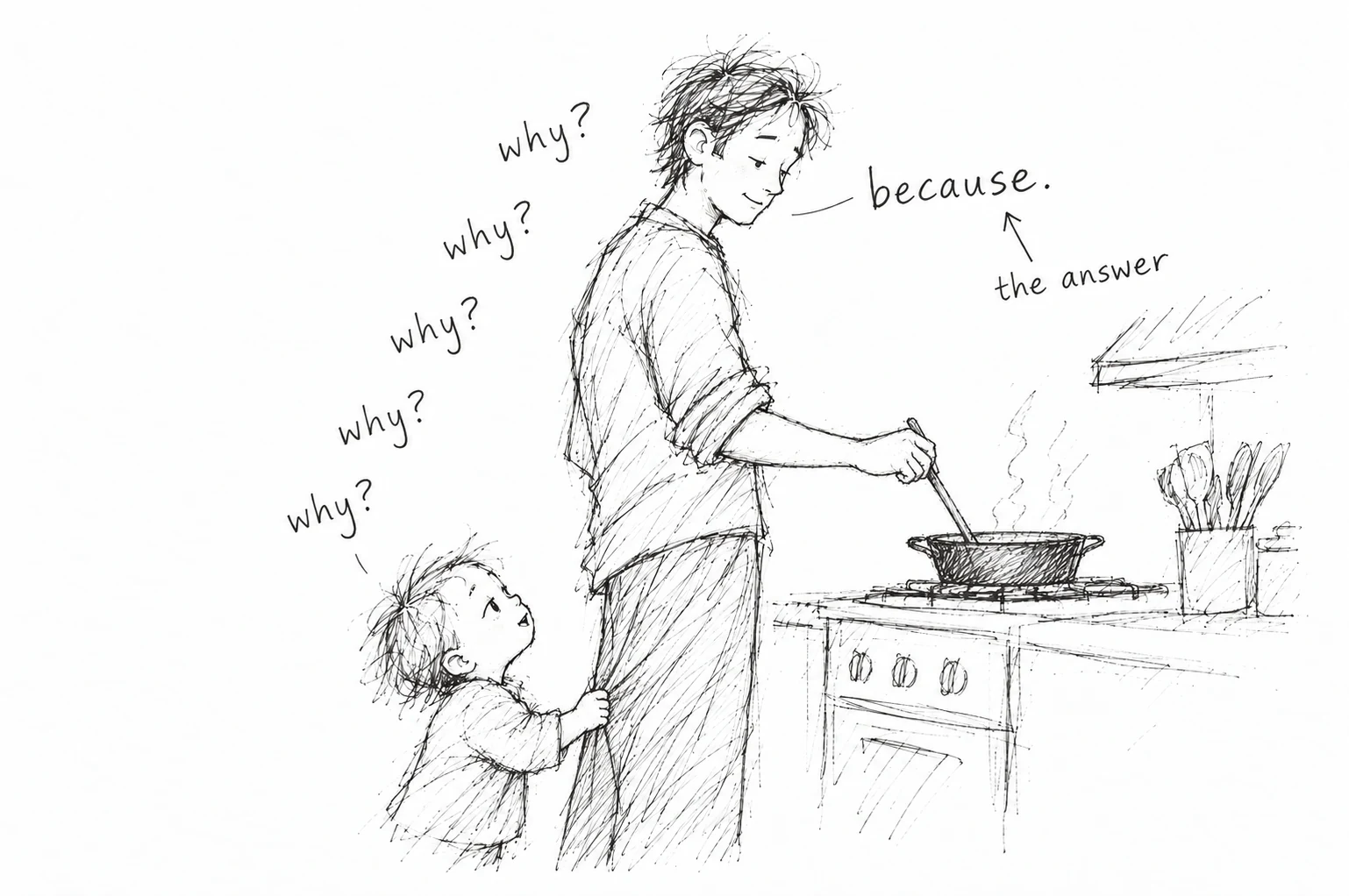
A follow-up can mean the answer worked
Getting another question does not necessarily mean your answer failed. It may mean the child has accepted it and found the next thing they want to understand. 1
Later experiments also found that preschoolers remembered explanatory answers better than answers that did not provide an explanation. The questions can be doing useful work, even when the conversation feels very long.2
You do not need a lecture on thermodynamics to leave the house. You may need shoes. Their purpose will be discussed separately.
Read Asking why in the Three chapter for the longer story, including what happens to questions away from home.
Sources and limits
These findings concern the children and situations studied. They do not establish a universal number of questions per day or explain every child’s behaviour.
1. What happens after an answer
Frazier, Gelman & Wellman (2009), Preschoolers’ Search for Explanatory Information Within Adult–Child Conversation. Family-conversation analysis and a laboratory study of preschoolers’ responses.
Back to text ↑2. Remembering explanations
Young Children Prefer and Remember Satisfying Explanations. Experiments examining children’s reactions to answers and their later recall.
Back to text ↑