Some three-year-olds lie to deny something they were told not to do. Their ability to produce a false answer is developing faster than their ability to keep the rest of the story consistent. A first lie can be part of ordinary development; it is not a verdict on a child’s character.1
You have looked at the toy. You say you have not looked at the toy. Asked what the toy is, you name it. The defence rests, having accidentally testified for the prosecution.
The toy test
In a study of 65 two- and three-year-olds, children were asked not to peek at a toy while the researcher was not looking. Most peeked. Older children were more likely to deny it, but most of the children who lied then gave away their knowledge of the toy. These results describe a small group in a particular test, not a percentage that applies to every three-year-old.1
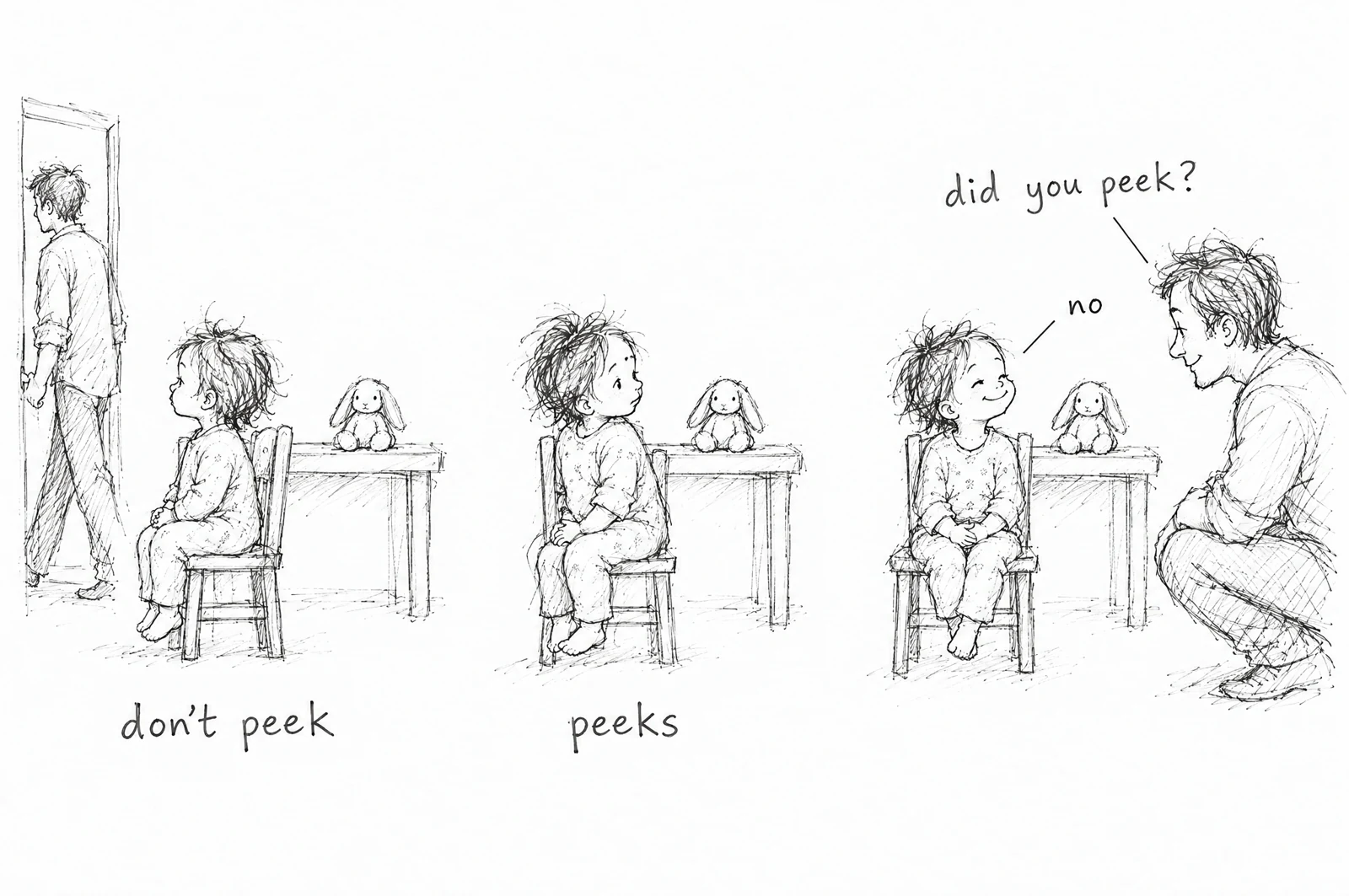
Why is keeping a lie going harder?
A convincing lie involves more than saying “no”. You have to keep track of what the other person knows and stop yourself blurting out something that gives the game away.
A separate study of children aged three to eight found that initial false denials were associated with understanding that someone can hold a mistaken belief, and with the ability to inhibit an immediate response. Maintaining a lie was associated with more complex understanding of other people’s beliefs.2
That is an association, not evidence that encouraging lies makes children cleverer. Nor can one denial tell you how advanced a particular child is.
In the full Three chapter, the investigation continues with the adults, who have also been asked whether they lie. Their report card requires some discussion.
Sources and limits
This is an illustrated explanation of research, not a test of an individual child. The household scenes are invented; the studies are real.
1. Early false denials
Evans & Lee (2013), Emergence of Lying in Very Young Children. A study of 65 children aged two and three using a forbidden-peeking task. A laboratory denial does not establish the motive for every untrue statement at home.
Back to text ↑2. The skills involved
Talwar & Lee (2008), Social and Cognitive Correlates of Children’s Lying Behavior. The reported links between lying, belief understanding and inhibition are correlations.
Back to text ↑