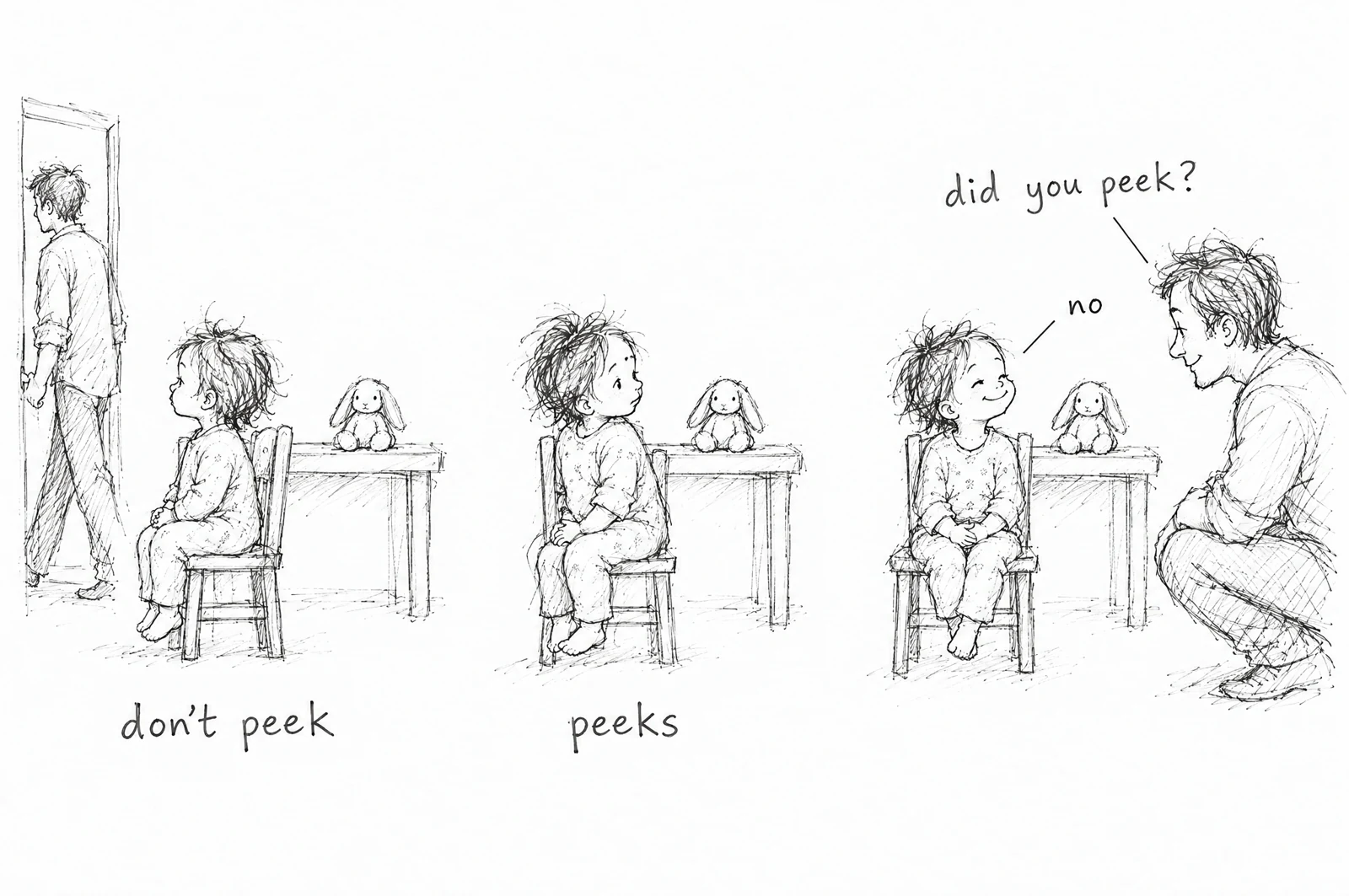
You are now three, and have started to lie. You have been able to for some months, and were bad at it, and are now good enough to be caught, which is how the adults know it is working. The first lies are about peeking. There is a test for this, in which a toy is set behind you and you are told not to look, and the adult leaves the room, and you look, as about four in five children do, and the adult comes back and asks. At three, somewhere between a quarter and a half of you who looked will say that you did not. By four, about four in five of you will. Adults shown the videos afterwards could not pick out the liars by their faces, except that more of the liars were beaming. The tester will record it as normal development, which it is. 1
This is also the year someone who loves you may tell you, perhaps for the first time, that big ones do not cry. Crying in front of someone is the first thing from the box to go that was not one of the four, in exchange for being called big, and it goes slowly. At three, boys and girls cry about as often as each other. By the end of primary school, asked to count back over the past month, girls report more than boys, and in adulthood the gap is wide. Nobody has shown that the sentence is the reason. 2, 3
In the meantime you ask why. In one study of thirty girls approaching four, they asked their mothers about twenty-six questions an hour at home, and one asked a hundred and forty-five during the recordings, a growing share of them why or how. When you ask why, the adult gives you an actual explanation about a third of the time. The rest of the time you get because, or a change of subject, or the name of the other parent. 4, 5
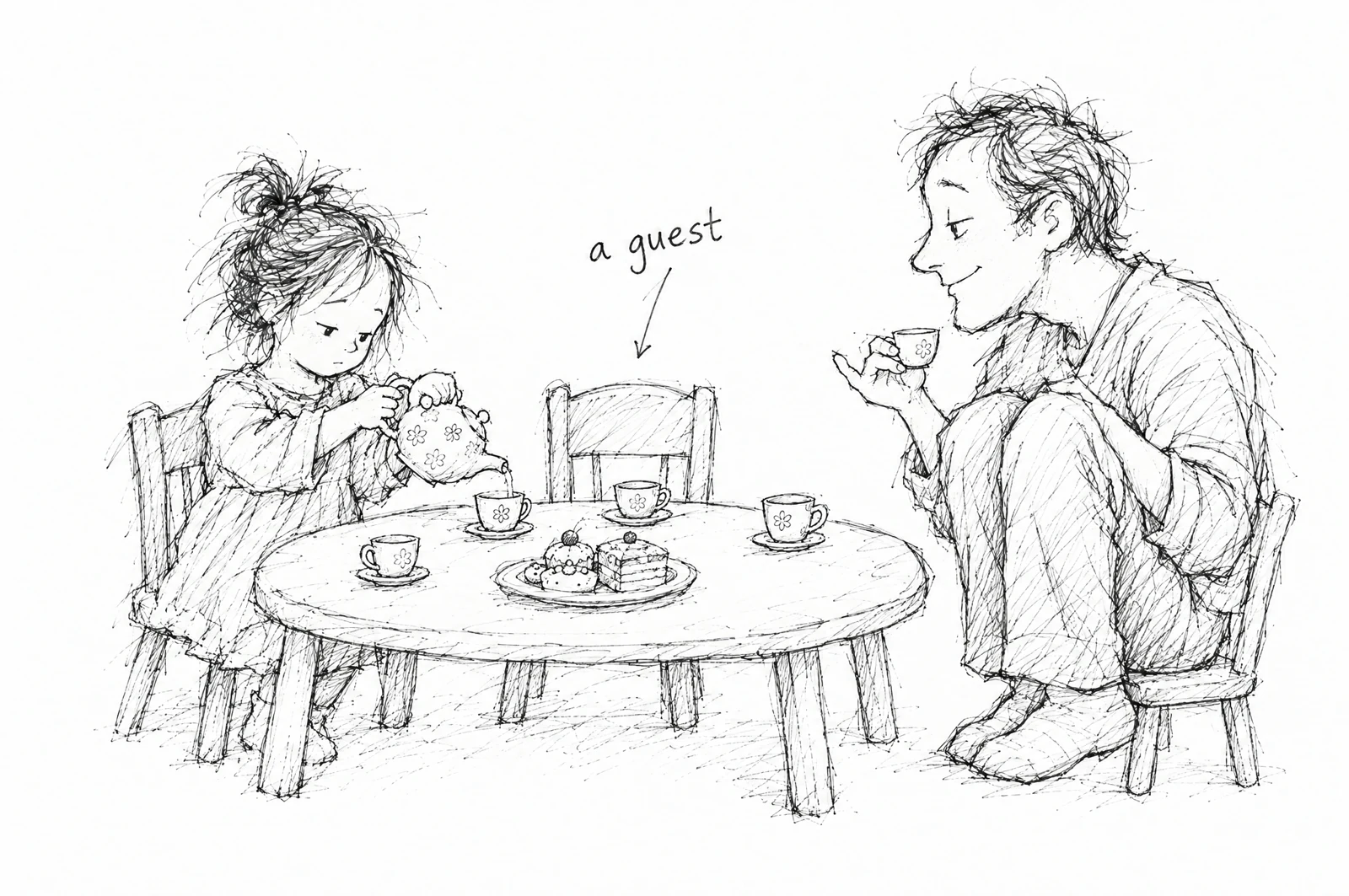
You may also have a friend nobody else can see, who has opinions about the seating. By seven, about two in three children have had one at some point, counting the toys that are treated as people, which you will insist is the correct way to count. The adults will lay a place. It is the only time in this Guide that a household makes room for a guest without first asking how long they are staying. 6
Four entries follow. You will be asked to stop two of them, you will get better at a third by watching the people who asked, and the fourth will be done to you.
Lying
The test is called temptation resistance, and its second question is the better one. Having said you did not look, you are asked what you think the toy is. About three in four of the youngest liars then name it. You will have said no, and then said the name of the toy, which in the 2002 study was Barney, and the researcher will have written down both. By six or seven, more than half of the children who lie will say they don't know, or name another toy, which is when the skill can be said to be finished. It has been linked to two other abilities: knowing that someone else can believe a thing that is not so, which about half the children in a large review of these tests managed by three years and eight months, and stopping yourself from saying the first thing that comes into your head. 1, 7
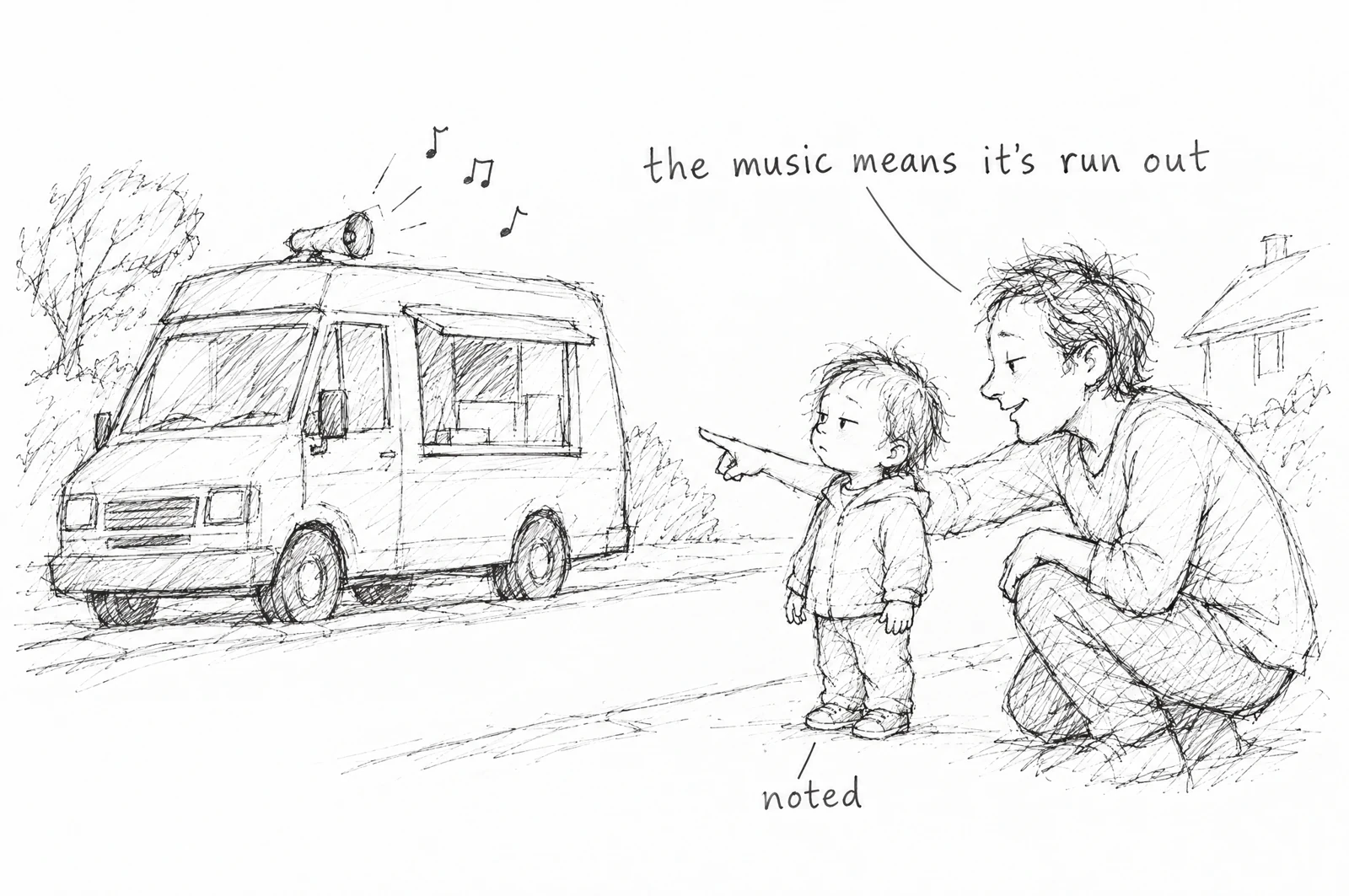
The people asking have also been studied. In one survey, 84 per cent of American parents and 98 per cent of Chinese parents said they had told their child at least one lie to get the child to behave. The most popular, in both countries, was that if you did not come now they would leave you here by yourself. In an earlier survey, three in four parents said they teach their children that lying is unacceptable, and the researchers wondered, in print, whether the parents had noticed. There is also the lie about the ice-cream van, which is that it plays its music when it has run out. It is not on the researchers' lists. A supermarket that sells ice cream asked two thousand people, and about one in twelve owned up to it. 8, 9
Asking why
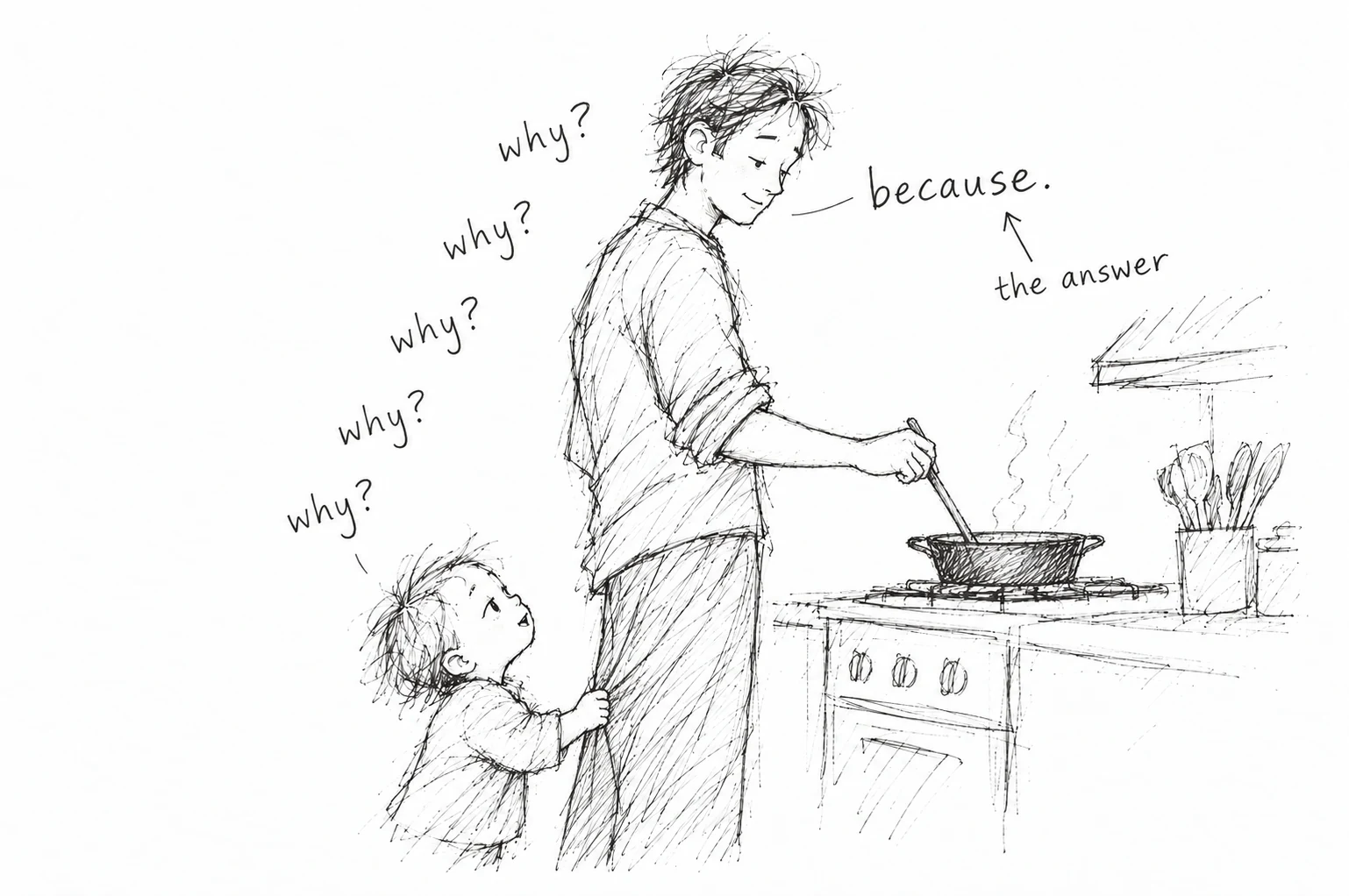
Why is the first question that cannot be answered by pointing. You ask it at the stove, in the bath, in the queue at the post office and at a funeral, of anything: why the dog, why the moon, why the man, why we have to, why not. When the answer is because, you ask again; in recordings of children your age, they re-asked about a quarter of the time after a non-answer, against about one time in ten after a real explanation, and now and then supplied an explanation of their own, which was wrong and better than because. 5
The rate does not travel. The same girls were recorded at nursery school, in the same months, and asked their teachers about two an hour. In other classrooms, of ten-year-olds, curiosity of any visible kind, counted across a class of about twenty-two, was seen less than once in two hours on average. 4
Adults still ask questions, and do not expect much from them. In studies of real conversations, including speed dates, people who asked more questions, especially follow-up questions, were liked more by the people they asked, and on the speed dates more of their partners said yes to seeing them again. 11
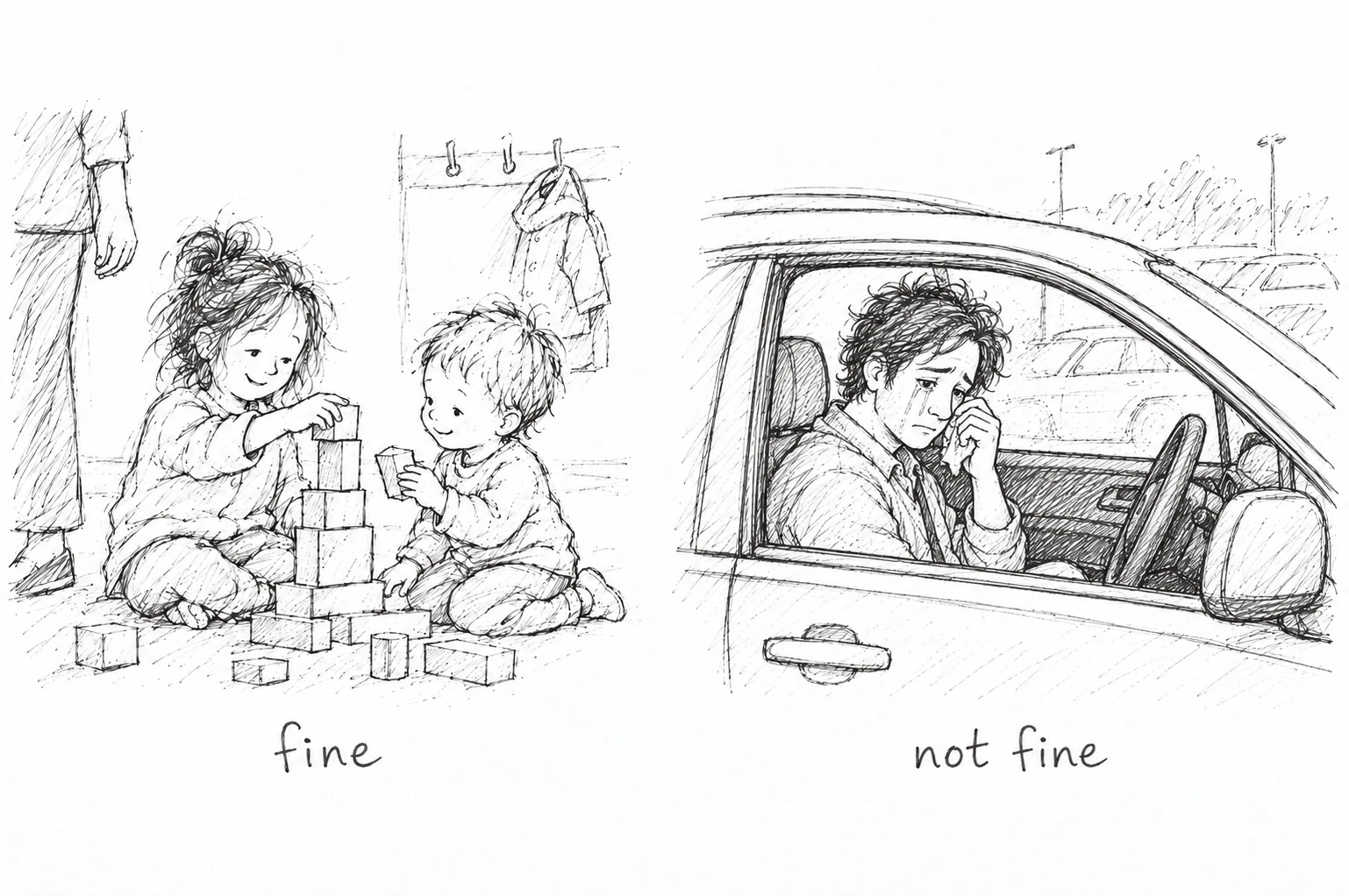
Crying, in front of someone
At birth, crying in front of someone was the whole method, and the someone was the part that worked. Now someone has suggested you do less of it. The sentence is usually said kindly, often on the way out of somewhere, by someone who wants the crying to stop more than they want to know what it is about.
What households actually do has been watched, and is less tidy than the saying. In one careful study of sixty families, fathers paid more attention when a four-year-old daughter was sad than when a son was, and the children went on to show the emotions that had been attended to. Across many studies, mothers turned out to talk about feelings with sons and daughters about equally. By about eleven, girls report crying more than boys do. In adulthood, in the studies most often quoted, women report crying between thirty and sixty-four times a year and men between six and seventeen. These are their own estimates, made mostly by students, and do not say who was in the room. 2, 12, 3
Being left
About now you may be handed over, for a whole morning, to a stranger who is paid to see to the four things, and who does, with snacks. Before you go, someone may tell you the lie that came top in the survey: that if you do not come now, you will be left here by yourself. You will come. You will then be left there, though not by yourself; that was the part that was a lie. 8
Being left has been on your mind since the second half of your first year. It peaked somewhere between one and two, and is usually fading by now. The United States government has put ten minutes on the list. It is on the official list of milestones for three-year-olds, which are things at least three in four children can do, and it reads: "Calms down within 10 minutes after you leave her, like at a childcare drop off." In a study of fifteen-month-olds starting childcare, cortisol, a stress hormone, rose over the hour after the mother left, in the first days, to as much as twice its level at home, and the securely attached group fussed and cried more during separation. That does not make the volume an attachment test. 14, 15, 16
This is roughly where your own records begin. Asked for their earliest memory, more than six thousand people gave one from a little after three, on average. Nearly four in ten placed theirs at two or younger, earlier than memories of that kind are thought to last, and kept them anyway. Some of what you keep from this year will be photographs, and some will be what you were told, and one item will be the line about the van, which you will say to your own child, in a street, with the van in full view, playing its music. 22
Sources and notes
Checked 22 October 2026. This chapter describes typical patterns around age three; individual children, families and childcare arrangements vary. The household scenes and the Guide's marks are comic inventions. Percentages from lying studies are shares of the children who peeked, not of all children. Superscript numbers lead to the relevant notes; the linked titles lead to the sources. Illustrations and selected factual and practical wording revised 25 October 2026; original references retained.
1. Lying about peeking
In the temptation-resistance test about four in five children peek. Among three-year-old peekers, 36% and 54% denied it in two experiments (Talwar & Lee); among four-year-olds, 100% (8 of 8) and 71% (12 of 17). In 2- to 3-year-olds, 25–33% denied it, rising to 90% at 43–48 months (Evans & Lee). Most young liars then named the toy (72–76%); more than half of six- and seven-year-old liars said they did not know or named another toy. Liars showed big smiles more often than non-liars (38% v 11%), and adults could not tell them apart by nonverbal behaviour. Samples were small.
Talwar & Lee (2002), International Journal of Behavioral Development 26:436–444 · Evans & Lee (2013), Developmental Psychology 49:1958–1963
Back to text ↑2. Crying in girls and boys
Parent reports find no clear difference between boys and girls through childhood; self-reports show girls crying more by about 9–13 (in a Dutch sample, 3.79 versus 2.92 cries in four weeks). A meta-analysis of 166 studies found only very small sex differences in sad or anxious expression in early childhood. No study shows that being told not to cry causes the later gap.
Jellesma & Vingerhoets (2012), Sex Roles 67:412–421 · Chaplin & Aldao (2013), Psychological Bulletin 139:735–765
Back to text ↑3. Adult crying
Self-reported estimates from older, mostly student samples. The commonly quoted range (women about 30–64 cries a year, men 6–17) is a press summary of these studies; some samples fall outside it (Israeli women about 17, men about 5).
van Hemert, van de Vijver & Vingerhoets (2011), Cross-Cultural Research 45:399–431 · APA Monitor (2014): Why we cry
Back to text ↑4. Questions at home and in class
The same 30 girls, just under four, asked their mothers about 26 questions an hour at home and their teachers about 2 at nursery school, in the same months; one girl asked 145 questions during the home recordings (as reported by Engel). Engel separately observed kindergarten and fifth-grade classes: among roughly 22 fifth-graders, curiosity was visibly expressed on average less than once per two-hour period.
Tizard et al. (1983), Journal of Child Psychology and Psychiatry 24:269–281 · Engel (2011), Harvard Educational Review 81:625–645
Back to text ↑5. Children's questions
In CHILDES transcripts, explanation-seeking 'why/how' questions rose from about 4% of children's questions at two to about 30% at five. Across 3,162 such questions from children aged two to four, adults gave an actual explanation 36.7% of the time; after a non-answer children re-asked 24.0% of the time (9.4% after an explanation) and offered their own explanation 10.7% of the time; after an explanation they asked a follow-up question 18.5% of the time.
Frazier, Gelman & Wellman (2009), Child Development 80:1592–1611 · Chouinard (2007), Monographs of the Society for Research in Child Development 72(1)
Back to text ↑6. Imaginary companions
In a longitudinal study, 65% of children had had an imaginary companion by age seven, including toys treated as people; about half of preschoolers' companions were based on props such as a special toy.
Taylor et al. (2004), Developmental Psychology 40:1173–1187 · University of Washington news release (2004)
Back to text ↑7. Lying, false belief and self-control
Children's first denials were linked to first-order false-belief understanding (knowing someone can hold a false belief) and to inhibitory control; keeping the lie going was linked to second-order belief understanding. A meta-analysis of 178 studies found half of children pass false-belief tasks at about 44 months. This is an average across tasks and samples, not a deadline for an individual child.
Talwar & Lee (2008), Child Development 79:866–881 · Wellman, Cross & Watson (2001), Child Development 72:655–684
Back to text ↑8. Parents' lies
84% of US parents (n = 114) and 98% of Chinese parents (n = 85) reported telling at least one of 16 lies meant to change a child's behaviour. The commonest in both countries was 'If you don't come with me now, I will leave you here by yourself' (67.5% US, 77.9% China). In an earlier study, 74% of parents said they teach children that lying is unacceptable; the authors suggest parents may not realise they are implicitly contradicting themselves.
Heyman, Hsu, Fu & Lee (2013), International Journal of Psychology 48:1176–1184 · Heyman, Luu & Lee (2009), Journal of Moral Education 38:353–369
Back to text ↑9. The ice-cream van
No research study has measured this lie. A UK poll of about 2,000 people commissioned by a supermarket (July 2025) reported that 8% said they tell children the van's music means it has run out. It was a marketing survey and is quoted as such.
Asda newsroom, 31 July 2025 · Coverage in the Yorkshire Post (archived copy)
Back to text ↑10. Children who have been lied to
186 children aged 3–7 were tested; half were first told a lie by the experimenter. Among 5- to 7-year-olds, those lied to were more likely to peek and then lie. Three- and four-year-olds peeked and lied at the same rates either way. The liar was a stranger, not a parent.
Hays & Carver (2014), Developmental Science 17:977–983 · UC San Diego news release
Back to text ↑11. Asking questions and being liked
Across studies of live conversations, people who asked more questions, especially follow-up questions, were liked more; in speed dating, a higher follow-up rate went with more second-date acceptances. Participants did not predict this. The speed-dating result is correlational. A 2025 audit corrected minor reporting errors and confirmed the conclusions.
Huang et al. (2017), Journal of Personality and Social Psychology 113:430–452 · Correction (2025), JPSP 128:669
Back to text ↑12. How parents respond to sadness
In a study of 60 families, fathers attended more to four-year-old daughters' sad and anxious expressions than to sons'; that attention predicted later expression. A meta-analysis of 34 samples found almost no average difference in how often mothers used emotion words with daughters versus sons.
Chaplin, Cole & Zahn-Waxler (2005), Emotion 5:80–88 · Aznar & Tenenbaum (2020), Sex Roles 82:155–162
Back to text ↑13. Responding to a child's emotions
In a randomised trial with 216 parents of four- and five-year-olds, a six-session course in emotion coaching increased coaching and reduced dismissing; parents and teachers reported fewer child behaviour problems afterwards.
Havighurst et al. (2010), Journal of Child Psychology and Psychiatry 51:1342–1350
Back to text ↑14. Separation anxiety
Separation anxiety commonly begins in the second half of the first year, peaks between about 12 and 24 months and usually eases by three. Timing varies.
AAP HealthyChildren: Making drop-off at child care easier · NHS: Separation anxiety
Back to text ↑15. Milestones at three
The CDC's list for three years includes 'Calms down within 10 minutes after you leave her, like at a childcare drop off' and 'Avoids touching hot objects, like a stove, when you warn her'. Each item is something at least 75% of children can do by that age; social-emotional items have the least normative data behind them.
CDC: Milestones by 3 years · Zubler et al. (2022), Pediatrics 149:e2021052138
Back to text ↑16. Stress when starting childcare
In 70 fifteen-month-olds starting childcare, salivary cortisol rose over the first hour after the mother left, during the first days, to 75–100% above home levels. Securely attached infants fussed and cried more during the separation. The study was of younger children than this chapter's reader. A difference between groups does not allow attachment to be diagnosed from crying volume.
Ahnert et al. (2004), Child Development 75:639–650
Back to text ↑17. Saying goodbye at drop-off
AAP guidance: a short, consistent goodbye ritual; say goodbye and then quietly leave; once you have left, do not reappear unless you are prepared to stay. The practical box makes the handover to a caregiver explicit and treats this as a consistent routine to agree with them.
AAP HealthyChildren: Making drop-off at child care easier
Back to text ↑18. Knowing it all along
Shown a familiar sweets box that held something else, most three-year-olds wrongly reported that they had expected its real contents; most five-year-olds reported their earlier belief correctly.
Gopnik & Astington (1988), Child Development 59:26–37
Back to text ↑19. Hindsight across the lifespan
194 participants aged 3 to 95: every age group showed hindsight bias, and preschoolers and older adults showed more than older children and younger adults.
Back to text ↑20. Copying pointless steps
Shown a puzzle box opened with both useful and pointless actions, young chimpanzees skipped the pointless ones when the box was transparent; three- and four-year-old children copied them anyway. Later studies found children kept copying despite warnings.
Horner & Whiten (2005), Animal Cognition 8:164–181 · Lyons, Young & Keil (2007), PNAS 104:19751–19756
Back to text ↑21. Sleep at three
The American Academy of Sleep Medicine recommends 10–13 hours in 24, including naps, for ages 3–5. Most children stop napping between three and five; timing varies widely.
Paruthi et al. (2016), Journal of Clinical Sleep Medicine 12:785–786 · Staton et al. (2020), Sleep Medicine Reviews 50:101247
Back to text ↑22. Earliest memories
In 6,313 respondents (figures as corrected in 2020), the average earliest memory dated to about 3.15 years; 2,479 (nearly 40%) were dated to age two or younger, which the authors consider likely to be fictional.
Akhtar et al. (2018), Psychological Science 29:1612–1619 · Corrigendum (2020), Psychological Science 31:1205–1207
Back to text ↑