You are now born. The Guide regrets that this entry reaches you roughly nine months after it would have been useful, but no earlier edition could be made to fit.
What has happened is this. You have been evicted from the only accommodation you will ever occupy that was warm, dark, free, and came with catering. On the usual route you have come out head first, through a door that required considerable negotiation, into a room much colder than anywhere you have ever been. Your entirely reasonable complaint about this has been greeted with delight. That was your first audience, and most of what there is to know about audiences.
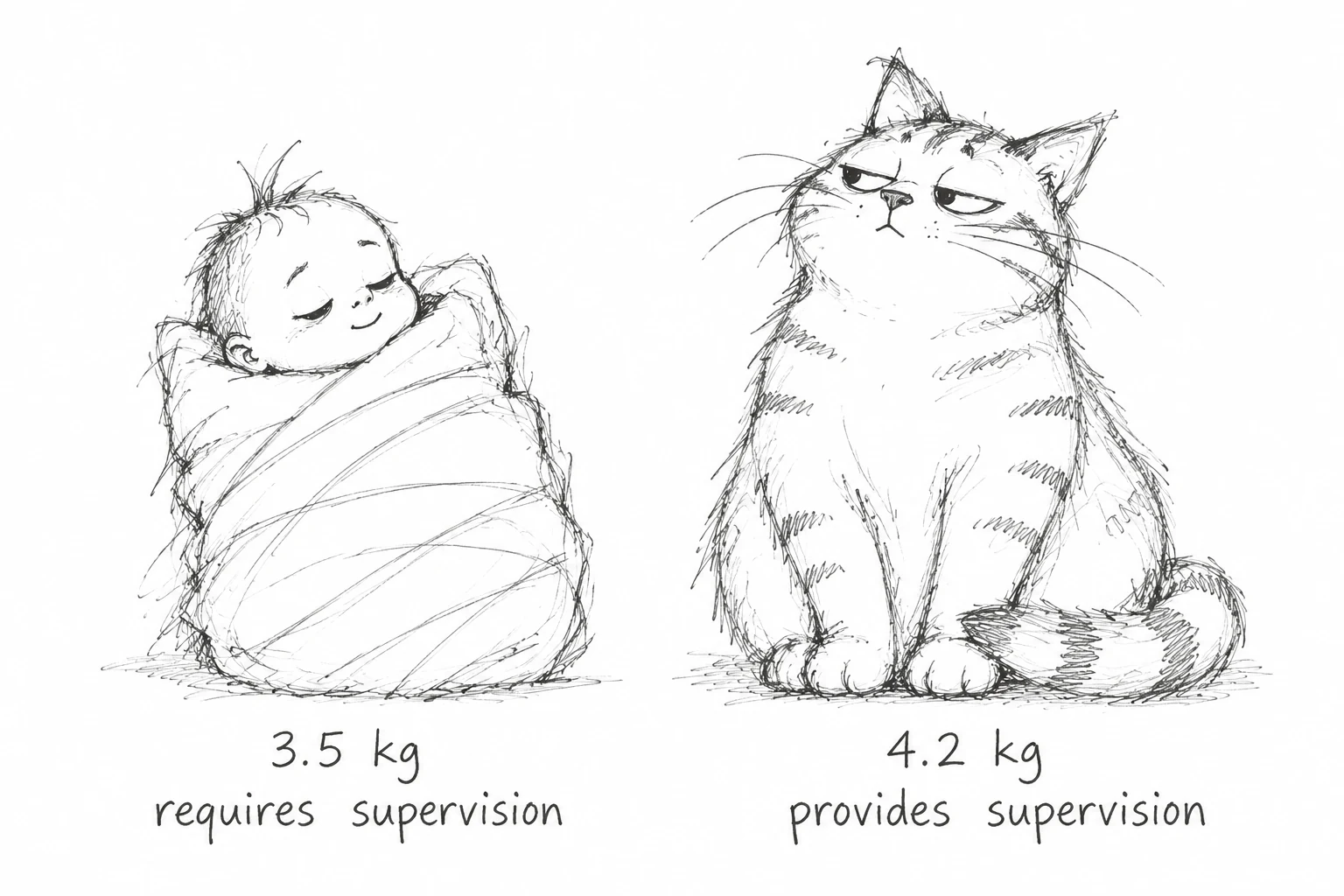
You are the size of a medium cat and carry the authority of a considerably larger one.
You are wet, and your circulation is changing its arrangements as your lungs take over. The hands and feet may look bluish for a while. Blood flow through the lungs increases, and the pressure changes begin closing a flap between the upper chambers of your heart. You have been outside for minutes and already the plumbing is being altered. 3
Breathing
Your lungs have never breathed air. Until now, oxygen has reached you through the placenta and umbilical cord. The placenta is a temporary organ that transfers oxygen and nutrients to you and carries waste products away: a considerable department to have working on your behalf before you have learned that departments exist. Now your fluid-filled lungs must begin taking in air. The first breaths take work. Most babies make the transition themselves; some need help. Either way, it is a lot of new responsibility to be given before anyone has introduced you. 3
You breathe mainly through your nose at first, although the mouth is not permanently out of service. You will also sigh: occasional deeper breaths that help keep the small air sacs in the lungs open. A sigh need not be a comment on your circumstances, though later a man with a course will teach you to produce one on purpose. 4
If you arrived through the birth canal, the separate bones of your skull may have overlapped a little, leaving your head temporarily conical and the photographs to be taken from the front. The gaps also leave room for growth. 6
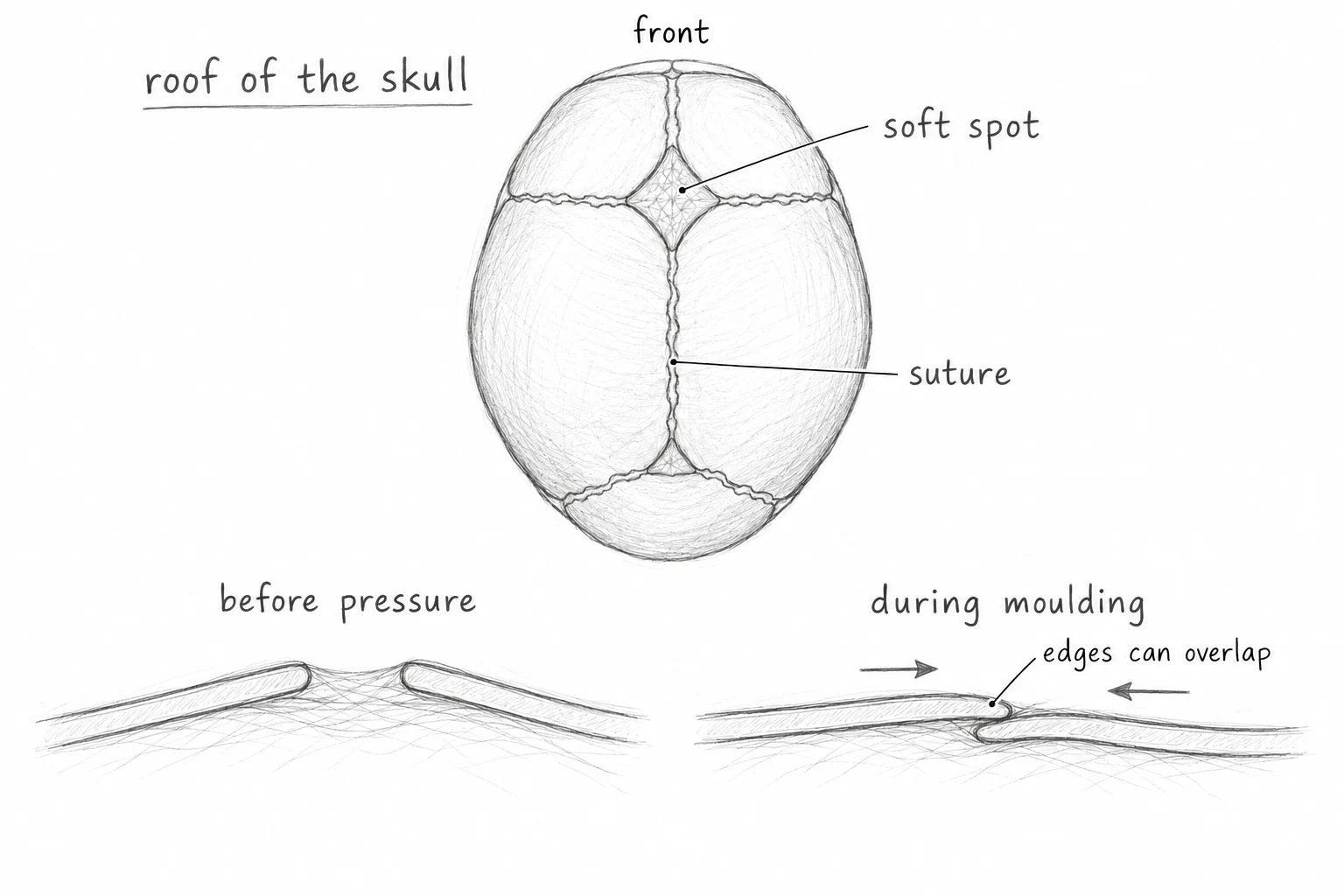
There may be a white coating on you called vernix, which has been doing what hand cream claims to do; it helps protect and moisturise the skin and can be left to absorb. You already make tears to keep your eyes moist. What may be scarce at first are the visible tears that run down the cheeks when you cry. The complaint can therefore arrive at full volume with very little supporting paperwork. 6
At one minute old you will sit your first examination, called the Apgar assessment. It is marked out of ten, it covers colour, pulse, reflex response, muscle tone, and breathing, and it is repeated at five minutes. The examiner is checking how you are adjusting to life outside. Ten is not guaranteed: blue hands and feet can cost a point. The first formal report on you may therefore say that you are doing well but are not quite perfect, a finding the world will go on reaching, with less equipment, for the rest of your life. 7
The room, let us say, is twenty-one degrees, which is comfortable enough for the people wearing clothes. You have come from a body at roughly thirty-seven. One of the first jobs is to dry you and keep you warm, often against someone's skin under a covering or, when needed, under a radiant warmer. A wet thing of your size loses heat quickly. Everyone in the room seems to have done this before except the people it is happening to, and the adults are watching the faces of the people who have, for information. One of those has already written the time on a form, before anybody had finished shouting, because in this room a birth is a shift, and the shift ends at seven. The lamp, if it is used, is the first machine to stand in for a body on your behalf. 9
Humans arrive with a great deal of growing left to do. A newborn chimpanzee's brain is roughly two-fifths of its adult size; yours is roughly a quarter to a third. These are measurements of size, not readings of how much of the brain is switched on. Human brain growth and development continue for years. The reason birth happens when it does involves the demands of pregnancy, the pelvis, and other constraints still being studied; the Guide cannot supply a date on which you would have been finished. 11
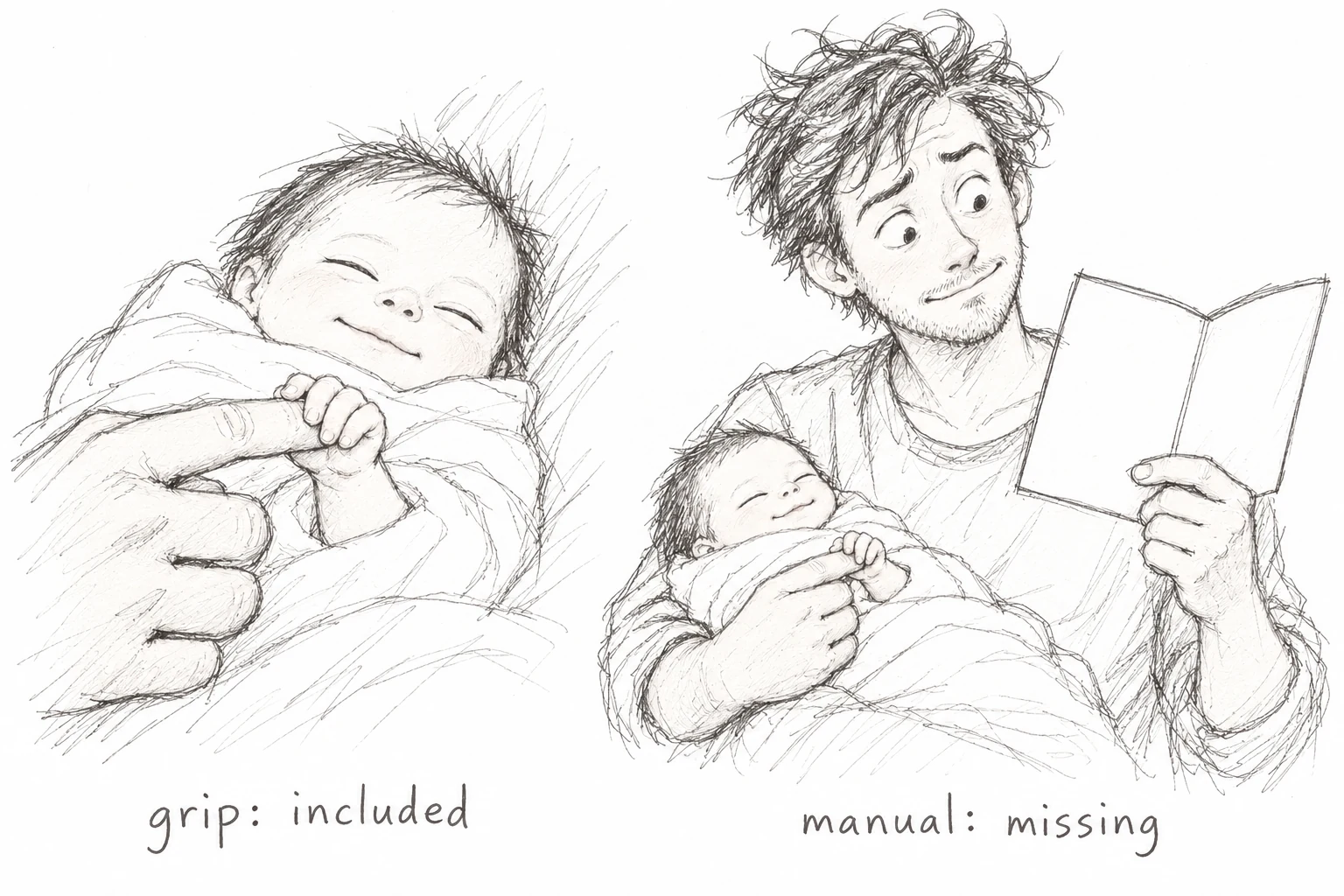
You can hold on to a finger, which is a reflex. Supported securely with your head held and your soles against a surface, you may make stepping movements, which are also a reflex; these usually fade in the first few months, long before independent walking. A considerable amount of learning will happen in the open, in kitchens and on the backs of buses, among people who have not agreed on a method. The language around you will become your language. So, in time, may someone's exact way of sighing at a drawer. You need other people for food, warmth, protection, and company, and they will discover the scale of the appointment before its terms become clear. 10, 11
Some newborns, placed skin-to-skin and given time, can make their way towards the breast and begin to suck. Others need help, and feeding is often something both people have to learn. If you are breastfed, the first milk is colostrum, usually thick and yellow and produced in small amounts. Milk may also reach you from a bottle, as expressed breast milk or infant formula. The method will attract opinions. Your immediate interest is in being fed. There may be a spell of alert looking, followed by sleep, which is a reasonable response to having arrived anywhere. 12
They will weigh you. You will probably lose some weight in the first few days, much of it fluid. A loss around a tenth of birth weight calls for a feeding and hydration check, not congratulations for following the schedule. Birth weight is often regained in about two weeks, though the timing varies and will be monitored. Nobody will ever again be so relieved to see you put on weight. They will measure your length, which involves straightening you out, which you may resist, having spent your life so far in the other shape, and your head, with a tape. In some hospitals someone will press your foot on an ink pad and then on a card, and that is your signature on the delivery note; it goes in a drawer and is never checked against the later ones. 13
You will be offered screening tests. The details and timing depend on where you are born: a few drops of blood from the heel can be checked for a group of rare conditions, and hearing can be screened while you are quiet or asleep. A screening result may lead to another test; it is not a promise that nothing will ever be wrong. This is your first encounter with the principle that a thing worth checking for may be worth checking for before anybody has complained. 14
For the first hours you may be, on the band around your wrist, Baby and a surname, which is the hospital's way of saying that the parcel has arrived and no one has opened it. Your parents have had months and a list and may still be in disagreement in the corridor. You will be given a name you were not consulted on, chosen partly to honour someone you will never meet and partly to avoid sounding like someone they did. They will settle it long before you understand it, and you may spend the rest of your life answering. In this family the deciding vote goes to whichever of them is more tired.
Being held
You will be passed around. There is a well-documented human preference for cradling babies on the left, though the reason is still debated. Whichever arm they choose, you are close to a body: warmth, movement, a familiar voice if it is the right person. Skin-to-skin contact can help keep you warm and calm. The adults are also getting to know you; the bond may be immediate or may take time. You have not set them an emotional deadline. 15
For now, being held is a large part of the arrangement. Later you will become selective about who is allowed to do it, and under what explanation. In one study of a hundred and eighty-eight embraces at the 2008 Olympics, the average lasted about three seconds. This was after winning or losing on the world stage. It is a modest allowance for four years of training. 16
The first photograph of you will be taken before you have a name, from above, by someone who has not slept, and sent within the hour to everyone the adults know, every one of whom will reply that you look like somebody. All newborns resemble the same furious elderly stranger, and every family recognises him.
In this family he is said, mostly by the mother's side, to have the father's nose.
You may go home within a day or stay considerably longer, depending on the birth, the health of you and your mother, and local practice. When the journey involves a car, there will be a seat and a strap. The seat was fitted in a car park by a person reading the instructions off a phone held in the other hand, and the dispute about it concerned whether it was in correctly, and was resolved by both parties checking it after the other had. The drive is the slowest the car has ever made. The one driving is braking for leaves. You sleep through it, and the people in front take your sleeping as a sign that you are fine and also, at every red light, as a sign that you have stopped breathing. The passenger keeps checking. The checking goes on, in one form or another, for about eighteen years, and then continues by telephone. The house will be as they left it, which is for the last time.
Crying
The manual was not in the box either.
Your parents discover this at about ten past three on the first night, having looked. There will be a book, or several, and a folder from the hospital, and a telephone, at the far end of which they will find other adults awake in their own time zones, holding a baby in one hand and typing with the other, every one of whom had believed until that moment that they were the only ones who had not been issued the instructions. You have one complaint and many possible reasons for making it: hunger, tiredness, discomfort, too much stimulation, a wish to be held, illness, and others the adults have not yet considered. You also have no indoor voice. They will try the possibilities in an order they will later describe as a system. One of them will work, or you will stop for reasons of your own, and the parent who proposed whatever was being done at the time will take the credit, quietly, and go on proposing it for months. It will sometimes work again, which is a difficult result to argue with. 17
In a review of twenty-eight diary studies, crying and fussing together averaged roughly two hours a day in the first six weeks. Individual babies varied a great deal. The figure does not entitle the adults to twenty-two hours off. By thirty you may do your crying in the car, with the windows up, and be answered by nobody, having arranged it so. 17
The outside world sounds different. During the latter part of pregnancy you heard a muffled version of it, along with sounds from the body around you. Familiar voices and close contact can be soothing now. The adults may buy a machine to make a steady background noise, in a house that already contains a washing machine. 19
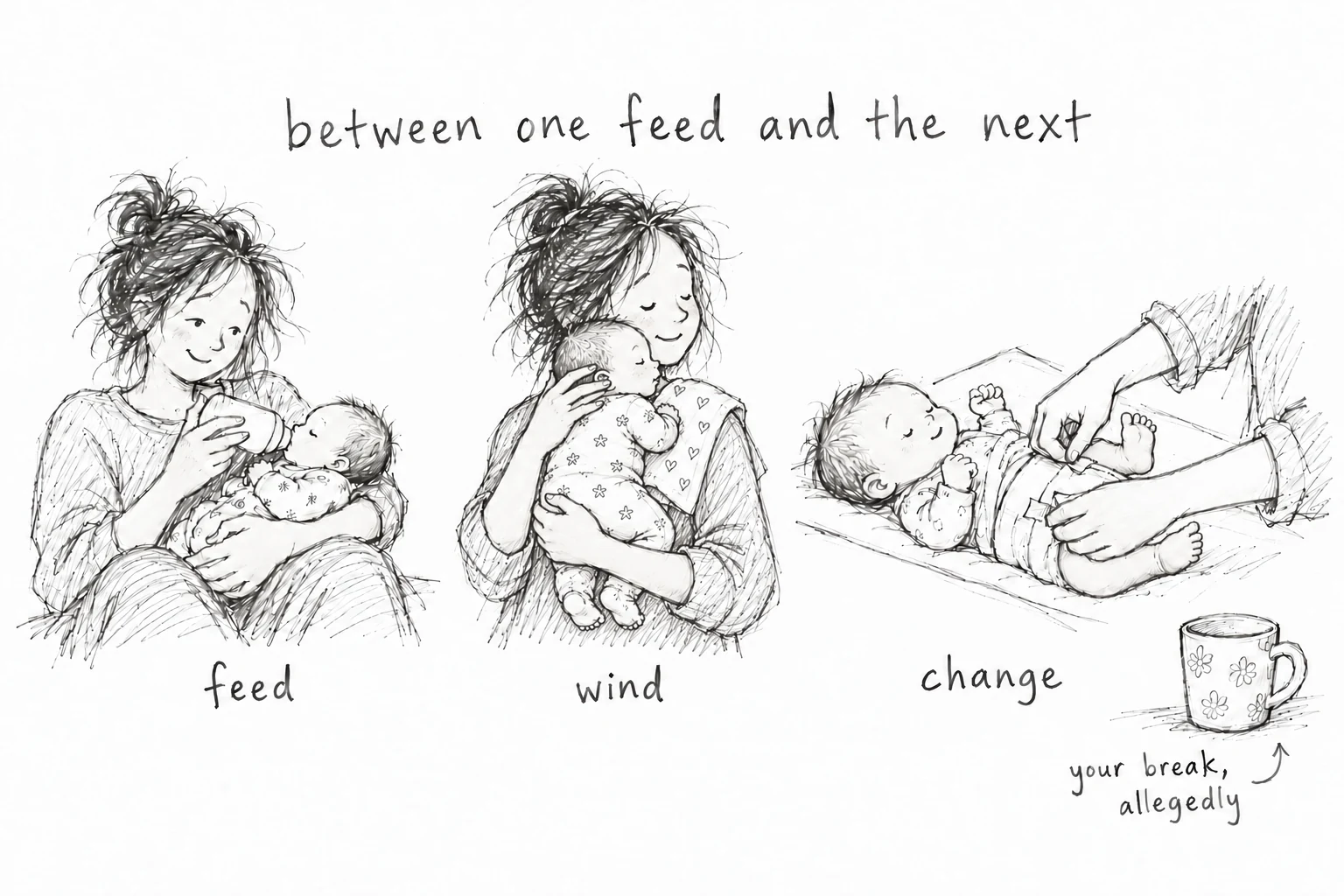
If you are breastfeeding, eight to twelve feeds or more in twenty-four hours is common in the early weeks. They need not arrive at regular intervals. A quoted gap is measured from the start of one feed to the start of the next; the adults are interested in whatever is left after feeding, winding, and changing you. That is a different number. The first poo is usually meconium, a dark green-black, sticky substance that looks as if it has been drained from an engine. Further nappies will follow, with considerably less interest from the photographic department. 12, 20
Sleeping
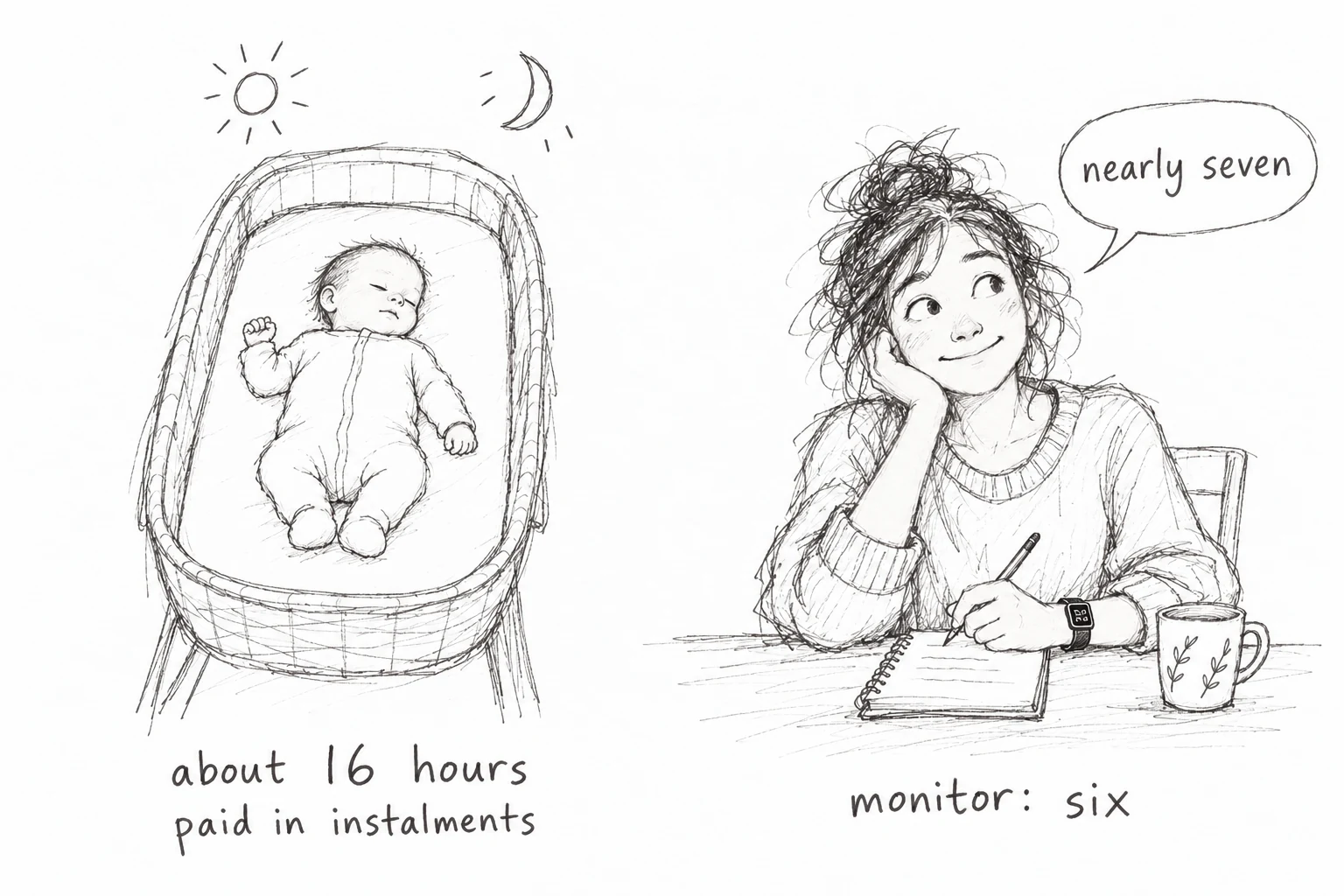
You may sleep around sixteen hours in twenty-four, though newborn totals vary widely. It comes in instalments, with little respect for whether the adults consider it night. Breathing can be irregular. Difficulty breathing, or blue or grey lips or tongue, needs urgent medical attention; the Guide does not award marks for waiting it out. 21
For sleep, you belong on your back in your own clear cot or bassinet, on a firm, flat surface. The safest arrangement is in the adults' room for at least the first six months. They can remain within reach without becoming the mattress. 21
Of the four instructions this is the one the adults will try to reorganise first. The entry for One returns to that negotiation. For now, your feeding and sleeping occupy a large part of their schedule. Later, in one study of middle-aged adults, people reported an average of six hours and forty-eight minutes of sleep while wrist monitors estimated six. Forty-eight minutes had been discovered in the telling. It is a method you may eventually adopt yourself. 22
The stump of the cable will dry, darken, and usually fall off within one to three weeks. In this household one parent will keep it in an envelope in the drawer with the footprint, and will never once look at it, and will always know exactly where it is. 23
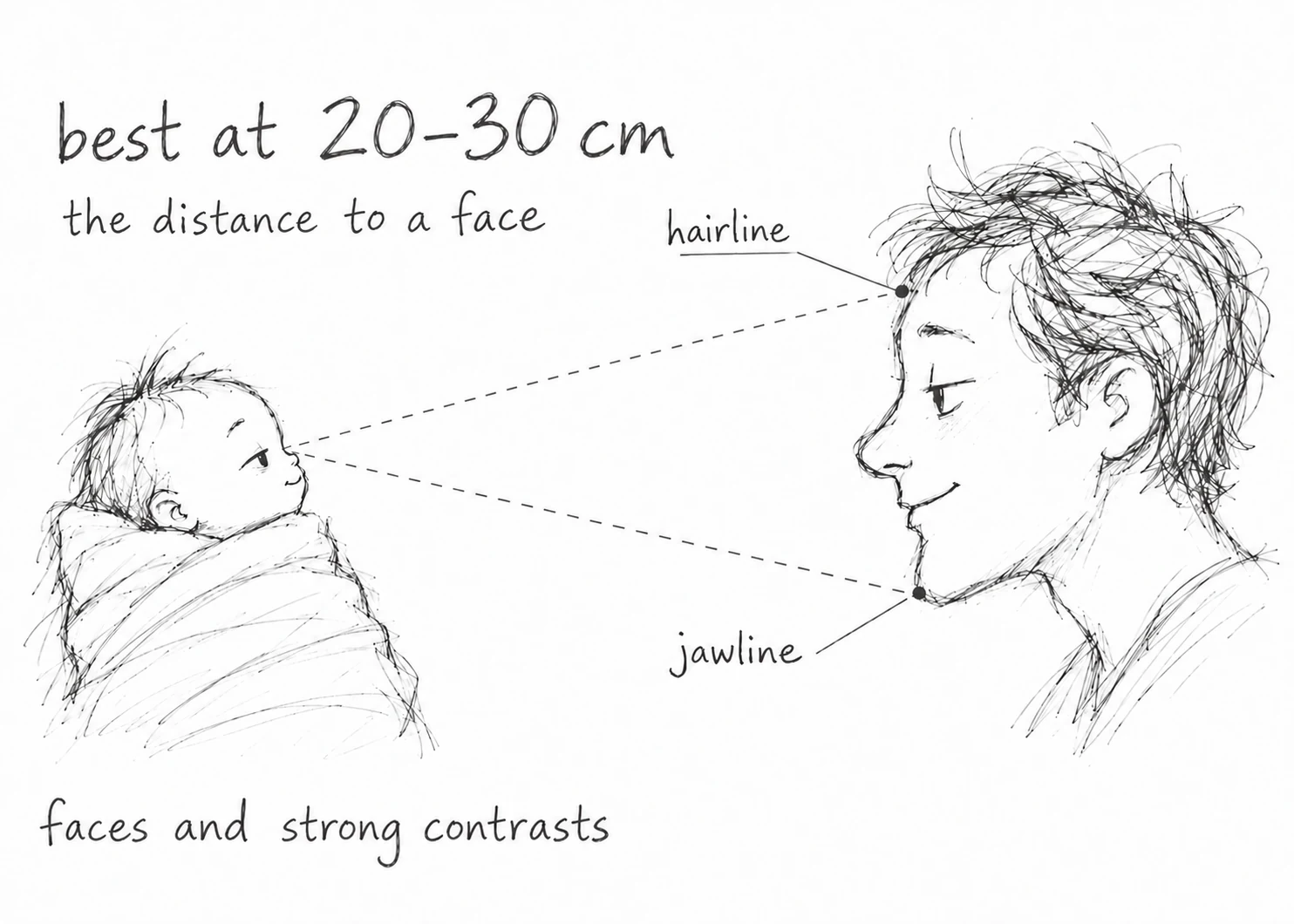
You see best at roughly twenty to thirty centimetres, which is a convenient distance for a face. Farther away, things are blurrier, but light, movement, and shapes do not disappear at a boundary marked thirty. Faces and strong contrasts attract your attention; a hairline may be more legible than the qualifications of the person attached to it. Newborns can already prefer a face looking towards them to one looking away. 24
Your mother's voice may already be familiar from before you arrived, the walls of your previous accommodation having been thin. Smells matter too. The voices come nearer when you complain. Within a fortnight the adults may tell visitors they can distinguish the hungry one from the tired one. They may indeed be learning your patterns, but the sound alone is no reliable dictionary. They will come anyway, which is the service you will go on receiving from people who love you: with concern, before they have understood the problem. 17, 19
Over the first couple of months, smiles in response to a face or voice begin to appear. Earlier smiles are not all social, although the adults will be tempted to explain every one as wind. The first one that counts in this family will be claimed by whichever parent was holding you at the time, while the other says you were looking at the light. 25
For the first several months the adults may conduct their most candid conversations as though you were not there. You cannot follow the argument, but familiar voices and patterns are already becoming part of your world. You will hear what each thinks of the other's mother, in the dark, at a volume meant for you. You will hear money discussed in the voice people keep for money. The thing one of them has not told the other is told to you instead, since you cannot pass it on, and so is the voice each of them uses when the other is out of the room, which neither of them has heard.
You are the only witness, and you are inadmissible.
Between the two of them, meanwhile, a system has grown up, and it was never discussed. One does the nights and is believed to be good at them; the other does the bath and is believed to be good at that; the belief, in each case, is held by the one not doing it. Neither has slept more than three hours together since you arrived, and each is keeping a count of the other's.
Those are your instructions for this stage, and you should know that you are not the only person in the room following them; the adults have merely added clothes. The two people now holding you have read nothing, agreed on nothing, and are each privately certain the other one knows what to do, which is the arrangement under which you will be raised and, later, the arrangement under which you will raise someone.
You will carry out these instructions perfectly, without having read them. You have about two years. After that they go back, one at a time, in exchange for the things the later entries describe, and the Guide keeps the originals here.
You weigh three and a half kilograms. The room is twenty-one degrees. Somebody is crying who is not you.
Sources and notes
Checked 22 October 2026. This chapter describes typical patterns around term birth and the early weeks; individual development and local care vary. The family scenes and the Guide’s marks are comic inventions. Superscript numbers lead to the relevant notes; the linked titles lead to the sources.
1. Caesarean birth
A caesarean delivers the baby through incisions in the abdomen and uterus. Regional anaesthesia is usual; contact and feeding depend on mother and baby being well enough. Recovery is from major surgery.
NHS: Caesarean section · NHS: What happens
Back to text ↑2. Size and the cat
The newborn and cat are illustrative individuals. About 50 cm is a typical term-baby length. The cat weight is grounded in a UK veterinary-population estimate; it is not a standard every cat meets.
Merck: Physical examination of a newborn · Becker et al. (2025), PLOS ONE 20:e0318734
Back to text ↑3. First breaths and the placenta
The placenta exchanges oxygen, nutrients and wastes. Lung aeration and circulation change after birth. The heart passage describes the foramen ovale beginning to close as pressures change.
MedlinePlus: Changes in the newborn at birth · NICHD: The placenta · Children's Hospital of Philadelphia: How the normal heart works
Back to text ↑4. Nose breathing and sighs
Infants breathe predominantly through the nose but can also breathe through the mouth. Sighs help maintain lung inflation. The study of the sigh-generating circuit was principally in mice.
Rodenstein et al. (1985): Infants are not obligatory nasal breathers · Li et al. (2016), Nature 530:293-297
Back to text ↑5. Adult breathing exercise
This adult trial compared daily five-minute practices for one month. Its mood findings support further study; they do not establish a universal treatment.
Yilmaz Balban et al. (2023), Cell Reports Medicine 4:100895
Back to text ↑6. Skull, skin and tears
Moulding can occur during vaginal birth. Fontanelles are covered by protective membranes. Vernix protects the skin. Newborns produce tears, with secretion increasing during the first weeks.
MedlinePlus: Newborn head moulding · NHS: Your newborn baby · Toker et al. (2002): Tear production during the neonatal period
Back to text ↑7. Apgar assessment
Five components are each scored from zero to two at one and five minutes. The Apgar score describes the baby’s condition and response to resuscitation, not an individual child’s future.
Back to text ↑8. Specifications
The heart and breathing figures are typical ranges, not diagnostic thresholds. Breaths are counted over a full minute because the pattern can be irregular. Some bones fuse during growth; see also notes 6 and 24.
Merck: Physical examination of the newborn · Nemours KidsHealth: Your bones
Back to text ↑9. Keeping warm
Drying, skin-to-skin care, covering and radiant warming help prevent heat loss. The chapter’s 21-degree room is a fictional setting, not a recommended delivery-room or home-sleep temperature.
AAP: Delivery-room procedures · NHS: What happens straight after birth
Back to text ↑10. Head control, heat and reflexes
Head control develops gradually; support is needed until the baby can manage it. Brown fat helps generate heat. Newborn reflexes and the timing of their disappearance vary.
CDC: Four-month milestones · AAP: Newborn reflexes · MedlinePlus: Changes at birth
Back to text ↑11. Brain size and development
The prose gives approximate neonatal-to-adult brain-size ratios: roughly a quarter to a third in humans and two-fifths in chimpanzees. Estimates vary by dataset and measure. Brain size does not measure intelligence or completed development; the species have different adult brain sizes.
Gómez-Robles et al. (2024), Nature Ecology & Evolution 8:133-146 · DeSilva and Lesnik (2006), Journal of Human Evolution 51:207-212 · Biazzi et al. (2025), PNAS 122:e2421095122
Back to text ↑12. Early feeding
Colostrum is the first breast milk. Early feeding may need support. Breastfed newborns commonly feed eight to twelve times a day or more, at variable intervals. Figure 4 is arithmetic, not a feeding plan.
NHS: Breastfeeding, the first few days · NHS: Early days
Back to text ↑13. Early weight change
Some initial weight loss is common. Loss around 10% calls for assessment. Birth weight is often regained in 7–14 days, but timing varies and should be monitored.
AAP: First office visit, 3-5 days · NHS: Early days
Back to text ↑14. Screening and leaving hospital
Screening programmes, timing and follow-up vary by country. A screening result is not a diagnosis or a guarantee. Hearing can be checked while the baby is settled or asleep.
NHS: Early days · NHS: Your newborn baby · NHS: Newborn hearing screening
Back to text ↑15. Cradling and bonding
A meta-analysis supports a population preference for left-sided cradling, with the explanation still debated. Bonding may be immediate or develop over time.
Packheiser et al. (2019), Neuroscience & Biobehavioral Reviews 104:30-42 · NHS: Building a close relationship with your baby
Back to text ↑16. Adult hugs
The three-second average comes from 188 Olympic embraces. A separate laboratory study compared one-, five- and ten-second hugs. Neither establishes an ideal duration for all embraces.
Nagy (2011), Journal of Ethology 29:389-393 · Dueren et al. (2021), Acta Psychologica 221:103441
Back to text ↑17. Infant crying
The roughly two-hour daily figure combines crying and fussing during the first six weeks, across 28 diary studies. A separate study of 39,201 cries from 24 infants found common causes could not be reliably identified from sound alone.
Wolke et al. (2017), Journal of Pediatrics 185:55-61.e4 · Lockhart-Bouron et al. (2023), Communications Psychology 1:26
Back to text ↑18. Adult crying
Retrospective reports associate social support with greater relief after crying. They do not prove that crying always helps or that company causes improvement.
Bylsma et al. (2008): When is crying cathartic?
Back to text ↑19. Familiar voices and smells
Newborns can prefer their mother’s voice. Familiar sounds, smells and contact can contribute to recognition and comfort; this is not mature understanding of speech.
DeCasper and Fifer (1980), Science 208:1174-1176 · NHS: Building a close relationship with your baby
Back to text ↑20. Meconium
Meconium is typically dark green-black and sticky. Nappy output changes during the first days and relates to feeding and hydration.
MedlinePlus: Changes in the newborn at birth
Back to text ↑21. Newborn sleep and breathing
Newborn sleep is fragmented and variable. For safer sleep: on the back, in a separate clear, firm, flat sleep space, in the caregiver’s room for at least six months. Breathing difficulty or blue/grey lips or tongue requires urgent help.
AAP: Stages of newborn sleep · NHS: Baby safer sleep advice · NHS: Urgent medical help for children under five
Back to text ↑22. Adult sleep
In the Chicago CARDIA sample, middle-aged adults averaged 6 hours by wrist actigraphy and 6.8 by self-report. Actigraphy estimates sleep. These are not figures for all adults or new parents. Adult sleep advice is for later life.
Lauderdale et al. (2008), Epidemiology 19:838-845 · CDC: About sleep
Back to text ↑23. Cord stump
The cord stump commonly separates within one to three weeks. The keepsake envelope is an imagined household detail.
Back to text ↑24. Vision and eye contact
Newborns see nearby objects best at about 20–30 cm, with no hard visual boundary. They can prefer direct gaze to averted gaze. The marked edges in Figure 6 are examples of contrast, not exclusive gaze targets.
AAP: Infant vision development · AAP: How your newborn behaves · Farroni et al. (2002), PNAS 99:9602-9605
Back to text ↑25. Early social responses
Smiling in response to a voice or smile is a milestone most babies reach by two months. Developmental milestones describe patterns, not rigid deadlines.
Back to text ↑26. Skull moulding diagram
The skull roof has separate bones joined by flexible tissues. Pressure during birth can produce temporary overlap. MRI observations show that the direction and amount vary. The diagram is a simplified explanation of the mechanism, not a measurement or a depiction of every delivery. It omits overlying skin and other layers.
MedlinePlus: Newborn head moulding · MedlinePlus: Sutures, ridged · Ami et al. (2019): MRI of fetal head moulding
Back to text ↑